HWPL Hosts Peace Governance Seminar at North South University in Dhaka – Exploring Institutionalization of Peace Based on DPCW

- আপডেট সময়: বুধবার, ১৭ জুন, ২০২৬
- ৬০৫ সময় দেখুন
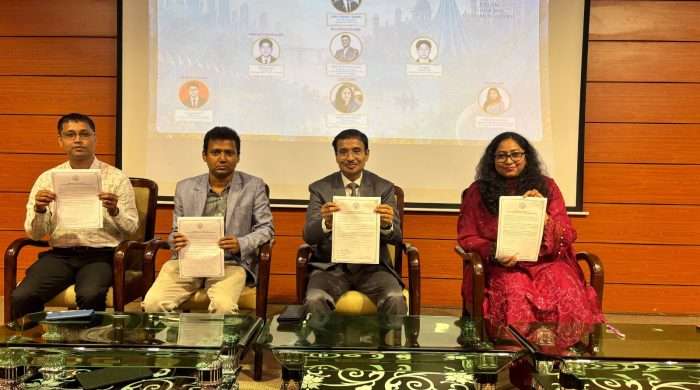
On June 13, HWPL and the Bangladesh Forum for Legal and Humanitarian Affairs (BFLHA) jointly hosted a public seminar titled “Institutionalizing Peace for Sustainable Development: Advancing DPCW-Based Peace Governance through Local Cooperation” at North South University (NSU) in Dhaka, Bangladesh.
Co-organized by the Centre for Legal Research and the NSU Law and Mooting Society, the event brought together approximately 100 participants, including legal scholars, human rights practitioners, policymakers, students, and youth leaders.
Bangladesh faces shared challenges in establishing the rule of law, protecting human rights, and advancing community-based peacebuilding. Against this backdrop, HWPL and BFLHA jointly organized the seminar to build a peace governance platform that brings together academia, the legal community, civil society, and youth leaders. The event aimed to explore pathways for institutionalizing peace based on the Declaration of Peace and Cessation of War (DPCW), while laying the groundwork for future local government resolutions and expanded peace education.
The seminar sought to build consensus on the necessity of DPCW-based peace governance and to establish a multi-stakeholder network connecting academia, law, youth, and civil society. It also served as a strategic platform for formalizing the HWPL-BFLHA cooperation framework and laying the foundation for expanding the Peace Governance Forum in Bangladesh.
The session was convened by Nasmin Jabin Noor, Senior Lecturer in the Department of Law at NSU. Opening remarks were delivered by Lokman Hossain, Senior Lecturer and Coordinator of the Centre for Legal Research at NSU, followed by an address from Session Chair Prof. Nasar U. Ahmed, Pro Vice Chancellor of NSU. Benjamin Kim, Coordinator of the Department of Peace Education at HWPL, then delivered introductory remarks introducing HWPL, the DPCW, and the Shanti Bangladesh Initiative.
Panelists included Prof. Md. Abdul Awal Khan, Professor at the School of Law of Independent University, Bangladesh (IUB); Prof. Md. Rizwanul Islam, Dean of the School of Humanities and Social Sciences and Professor of Law at NSU; and Jacob Bae, Coordinator of the International Peace Youth Group (IPYG). The panel discussion was moderated by Sayere Nazabi Sayem, President of BFLHA.
Session Chair Prof. Nasar U. Ahmed emphasized that diversity is central to building peaceful societies, noting that people belonging to different groups, cultures, and religions forms the very foundation of peaceful coexistence. He added that NSU contributes to societal progress through knowledge creation and by responding to both national and international challenges that threaten peace.
Prof. Md. Rizwanul Islam noted that achieving peace in a country like Bangladesh presents significant challenges, stressing that peace cannot be reduced to the mere absence of violence. He observed that international humanitarian law has been seriously challenged in conflict-affected regions such as Iran and Gaza, and pointed out that Western powers sometimes apply human rights and peace principles selectively, despite their advocacy for these values.
During the event, all participants signed the “Declaration of Peace and Cessation of War” endorsement letter, reaffirming their commitment to the promotion of peace and peaceful conflict resolution. A commemorative photo ceremony was also held to mark the signing of the MOU between HWPL and BFLHA, formalizing the partnership between the two organizations. The event concluded with the presentation of tokens of appreciation to the distinguished guests.
Through this seminar, HWPL and BFLHA established the groundwork for building a university, legal, and youth-based peace network in Bangladesh. HWPL plans to steadily expand DPCW-based peace governance through ongoing efforts to collect DPCW endorsements, broaden peace education, and advance local government resolutions in the country.